

12: Trix & PerfectBee
My next beekeeping experience was not really a beekeeping experience, but it was still awesome.
I mentioned in a previous blog that I am working on some CEUs by preparing to eventually interpret a beekeeping class. I really want the Deaf community to have access to this magical world.
Well, I met with my mentor, the great Patricia “Trix” Bruce while in the Seattle area to ask for her help. I call her the "CLassifier Queen" with her extensive history in ASL Storytelling performance ad poetry, plus, she had posted this quick video showing how bees pollinate flowers.

For those who don’t know, America Sign Language (ASL) uses something commonly called “classifiers” (or CLs) to add further information to a concept that has already been set in conversation. So, CL's aren't signs in-and-of themselves, they add information to signs. If a certain CL is used for consistently for one concept in the Deaf community, it can evolve into a designated sign, but the category, in general, is separate. CLs are used a ton in the Deaf community's creative outlets, like storytelling and poetry, which they value much like hearing people value music.
American Sign Language users who incorporate at lot of CLs appropriately are typically seen as stronger ASL user and are seen as more "more Deaf", regardless of actual hearing status.
The reason is because CLs are unique to signed languages, they don't exist in most spoken languages. So, the less connected a person is to spoken English while signing, the more fluent they are in ASL. Most hearing folks, like myself, struggle to organically produce CLs because it's just not natural for me. Don't get me wrong, I LOVE me some CLs, but I don't naturally "think outside the [hearing] box".
So, as a specific example related to beekeeping, note the frame below:
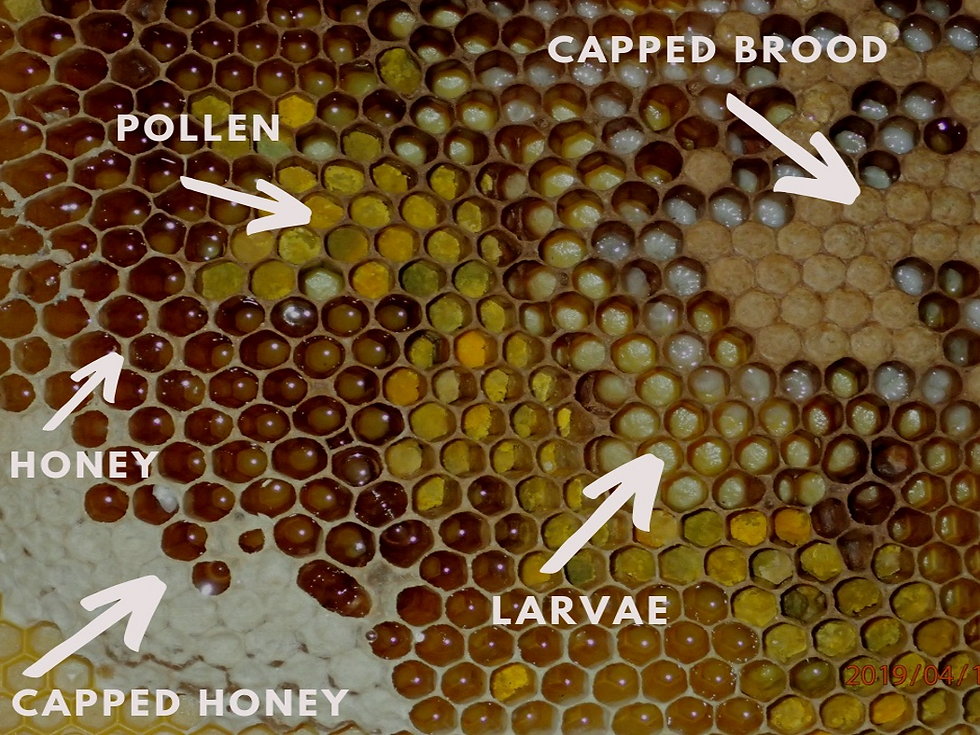
All the terms above should be set up by fingerspelling them first so that the terms are known and specificity has been identified.
But after fingerspelling the terms, I don't want to keep fingerspelling them every time the term is used...imagine a Deaf person trying to do that while wearing beekeeping gloves!
The problem?
Only the word "honey" has a sign, which means all the rest of what's shown in the picture would have to be explained, with adjective and lots of CLs.

The problem with that?
The differences between each concept shown is subtle, they're all the same size, similar colors, similar texture, yet display importantly distinct bits of information.
How do I sign that!?
Summon Trix!

Trix was so helpful!
She not only helped with the example above, she helped me figure out how to visually construct the lifecycle of the honey bee.

We also discussed the mating/reproductive process and how to make that make sense visually (yes, I had the "bird and the bees talk with Trix Bruce).
This was fascinating and I was so glad I asked.
She also greatly simplified how I'd explain the parts of a Langstroth hive:

My plan is to continue gathering information, opinions, and approached from other Deaf people and then make videos demonstrating some of these concepts.
That way they can be documented as a starting place then grow from there.
I will continue my quest for knowledge and skill!
I mentioned in my blog "7: Inspired Academics" that I am registered for the class all the locals recommend, the Apprentice Beekeeper Certification from Washington State University.
Well, I'm thrilled about it and see it as the main way to easy myself into my first beekeeping season. Also, I've had a couple people ask if it would be weird to join with me.
No, it's not weird! Please, experience this with me; Aubrey Hoxie- I'm talking to you!
Kimmy, if you want to do it- go for the February 26th class. 😉
But, with my current enthusiasm and insatiable appetite for anything bees, I just couldn't wait for February to be my first class.
I registered for online classes with PerfectBee. instead

These classes also count for my interpreting CEUs, as General Studies, which is a relief to finally get those satisfied.
As I’ve began the first course, I’m seeing that it’s going to take a fairly significant amount of time even though they are not courses accredited by a college, so I may request more credits from RID after the start of the new year.
Anyway, it has been fantastic! It certainly would not be a good thing to do instead of a local beekeeping apprenticeship, but in addition? YES. I like that I have unlimited access to all education, their forum, blogs, special webinars, and even a discount on their retail shop, which is extensive.
Also while I was driving on my Api-Journey, I listened to the podcast, Beekeeper Confidential.

There were a few episodes that I loved, a few that were kinda meh, and a few I skipped after a few minutes. But the overall, I'd consider myself a listener.
A couple of my favorites so far:
The host, Mandy Shaw, definitely has a passion for beekeeping and seems like the kinda gal that would be cool to have coffee with. She has definitely opened my eyes to the interest in swarm catching- I already plan to ask one local guy if I could tag along next spring on a swarm catching trip or two. Fascinating!
One episode, the guest is talking about reading the bees- a very important part of beekeeping. As he's discussing this further, he makes the matter-of-fact statement "bees are deaf".
What, what!?!

My very first action was to text Kimmy, a young lady friend of mine who is Deaf and recently interested in bees.
My second action was to post on facebook while at a Rest Stop.

One of the comments pointed out that a new Queen of a colony will emit a certain sound as a show of dominance to claim her royal position, which is true, so I then doubted the information.
After googling it, I found that honeybees were assumed to be deaf for ages because they don't have ears but after research has been conducted, it's indicated they can detect sound.
Well, as a professional involved with the American Deaf community, I can confidently declare that detecting sound and even appropriately responding to it is not a definitive indication of hearing. Deaf people respond to stimulus all the time that seem to be a response to sound, to us hearing folks, but the response is actually based on another sense, usually sight or touch.
Well, in PerfectBee's first course, just a couple lessons in, they talk about the anatomy and function of the honeybee.
Here's a screenshot from their site and my notes:

Honeybees detect sound by using their other senses. So,
It's true! Honeybees are DEAF!
No wonder I love them so much; no wonder their communication system has been compared to a nonverbal human language; no wonder they're so socially collective.
So many parallels!
When I discovered this, it became further affirmation that my new business venture isn't as odd as it seems. If a Deaf person were teaching a beginning beekeeping class to other Deaf people, for example, they could easily make comparisons to their own abilities, experiences, and hidden superpowers.
I can't wait to learn more!

Photo by J. Steven Robertson of Emmisoure Photography and https://bees.photo


Comments